


How Economic Crises and Wars Impact Gold Prices?


In September 2008, Lehman Brothers, the American global financial services firm founded in 1850, collapsed miserably.
Global credit markets froze overnight, with stock markets falling 40 to 50% over the following months. Gold entered 2008 at around $850 per ounce, which initially fell alongside everything else as investors desperately raised cash.
But then recovered and kept climbing for three years, leading to a hit of nearly $1,900 by late 2011, and triple the pre-crisis level.
COVID-19 was the same, but faster. The price was $1,550 in January 2020, and then markets crashed in March, where gold briefly fell.
Then, central banks started printing money at scales nobody had seen before. Governments ran deficits that would have been politically impossible the previous year. Again, gold hit $2,067 in August with a new all-time high within six months.
What’s common in both cases?
Central banks are responding with lower rates and expanded money supply. Lower rates reduce the cost of holding gold, which pays no interest anyway.
The curious question here is Why gold specifically? Not the dollar, not bonds, just gold!
What is it about this metal that makes it the default destination when the world feels uncertain?
That’s what this guide is actually about. The focus is on closely analysing the impact of crisis and wars on gold and understanding the reasons for it.
Do Wars and Economic Crises Increase Gold Prices?
Short answer: Almost always, yes! Not perfectly. Not the same amount every time. But consistently enough across enough different types of crises in enough different countries that the pattern is essentially reliable as a directional call.
The World Gold Council has tracked gold’s performance across geopolitical stress events since the 1970s. Prices rose in the majority of major conflict scenarios. Particularly in the early weeks, when nobody knows how bad things will get and uncertainty is at its peak.
The reason isn’t complicated – Gold has no counterparty. A government bond needs a government behind it. A stock needs a company with future earnings.
But gold just exists, and no institution needs to honour any promise for gold to hold value. When the institutions themselves look unstable, that property becomes enormously attractive very quickly.
Why Gold Prices Rise During Wars?
Wars don’t create one problem. They create several issues simultaneously, including currencies weakening, and governments spending heavily, leading to inflation risk rises, supply chains breaking somewhere, and energy prices spiking.
Financial markets start pricing in scenarios nobody can model with any confidence. All of that uncertainty lands on the same trade.
Buy gold. But why?
According to CNBC, when Russia invaded Ukraine in February 2022, the gold jumped roughly 5.5% in the following weeks, not because Ukrainian gold mines were affected. But the investors across Europe suddenly faced energy shocks, accelerating inflation, and uncertainty about how far the conflict would spread. Capital moved toward assets that don’t depend on any particular geopolitical outcome being okay.
That’s the entire mechanism. Nothing more complicated than that.
Analysis from the World Gold Council shows gold consistently outperforming most asset classes during periods of elevated geopolitical stress.
How Economic Crises Influence Gold Prices?
Open any financial news site the day a war starts. Gold is all time high. Not always immediately, but sometimes it takes hours. However, the direction is almost always the same. This pattern has repeated so consistently across history that serious investors stopped asking whether it would happen and started asking how much.
An expanded money supply raises serious questions about what inflation does to savings over the next decade. Both effects support gold throughout because it is considered a safer asset in conflict situations. The reason for it is way simpler – Gold has been a reliable source of investments for decades among people, popular for trading and exchange purposes.
Gold as a Safe-Haven Asset
Safe-haven means something precise, not just goes up when things are bad.
An asset that holds value when other assets are falling and when confidence in financial institutions is genuinely low, three things make gold qualify when most assets don’t.
No counterparty risk and nothing needs to be honoured by anyone for gold to be worth something.
Low or negative correlation with equities over long periods. This is when stocks fall drastically, and gold often rises. This is not always the situation, but enough for the right moments.
Gold has a universal recognition in every country, every culture, and doesn’t require trust in any specific currency or financial system. That matters most exactly when trust in specific currencies or systems is precisely what’s under question.
Another important thing to note is that the Central banks globally hold tens of thousands of tonnes of gold in reserves. These institutions have access to every financial instrument ever invented, and they still hold physical gold because it’s worth sitting with that.
Historical Examples
2008 financial crisis
Gold was $850 at the beginning and nearly $1,900 by late 2011. In three years, the global economies rebuilt from the worst financial collapse since the 1930s, whereas the gold just kept climbing.
COVID-19 2020
Gold at $1,550 in January 2020, then hit $2,067 in August, 2020. That was the new all-time high. Money was printed at an unprecedented scale, and real concern was about what that does to currency values in the long term.
Russia-Ukraine 2022
Gold jumped sharply in the weeks around the invasion, then consolidated as the Federal Reserve began aggressive rate hikes. Classic pattern of safe-haven spike followed by rate-driven consolidation.
2024
Gold crossed $2,400 in April and kept climbing due to the Middle East conflict, and the record of central bank buying from China and India led to persistent inflation. This scenario caused growing de-dollarisation and multiple tailwinds simultaneously.
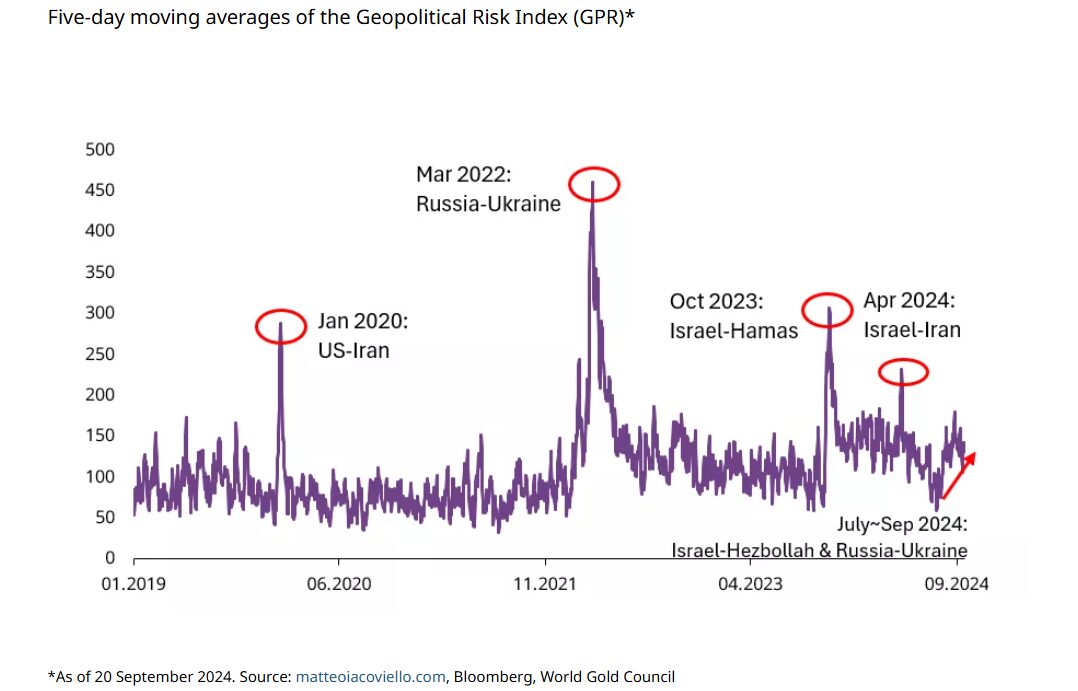
Check the graph below – Different conflicts, different regions, different decades, but the exact same pattern.
This not only highlights the demand for gold during conflicts but also proves the investor’s confidence in gold.
Key Factors Driving Gold During Wars
Safe-haven buying
The first step for every investor is to sell equities and buy gold. This happens fast and sharp price spikes in the first days of conflict, before most retail investors have even processed what’s happening.
Inflation and currency depreciation
Wars are expensiv so deficit spending and money printing create inflation. Then, inflation erodes cash, and gold’s supply grows slowly regardless of what any government decides. That’s the difference.
Supply chain disruption
Russia is a significant gold producer. Sanctions on Russian gold exports added supply pressure on top of already elevated demand after the 2022 invasion.
Central bank buying
Central banks have accumulated over 1,000 tonnes of gold in each of the last three years, the highest pace in decades. Countries diversifying away from dollar reserves, particularly after Russia’s frozen dollar reserves showed exactly what holding sanctionable assets means in practice, accelerated this dramatically.
Wars, Currencies, Inflation, Gold
The inverse relationship between the US dollar and gold prices is consistent and well-documented. Gold is priced in dollars globally. So, when the dollar weakens, gold prices go up.
However, wars weaken currencies in affected regions directly. In countries, funding military support is indirectly achieved through deficit spending. Wars create inflation through energy price spikes, food supply disruption, and broader supply chain breakdown. Every one of those channels erodes the real value of cash while supporting gold.
Research from the National Bureau of Economic Research has examined gold’s role as a long-run store of value and inflation hedge, with findings suggesting gold maintains purchasing power over extended periods even as cash and nominal bonds lose real value.
Gold Demand in India During Global Crises
India is the world’s second-largest gold consumer. In November 2024, central banks globally added a combined total of 53 tonnes of gold to the Reserve Bank of India (RBI), according to the World Gold Council (WGC). Domestic prices follow global prices closely, adjusted for the rupee-dollar exchange rate.
That exchange rate is where it gets interesting for Indian investors. Global gold prices rise in dollar terms during crises. The rupee typically weakens against the dollar simultaneously. Indian investors see both effects at once. Higher dollar price, weaker rupee to convert it.
During COVID-19, gold in rupee terms significantly outperformed gold in dollar terms for exactly this reason. Two effects, same direction, simultaneously. Investors who held gold through that period benefited from both.
Beyond investment, gold in India is savings. Gold is a security and social capital across generations. That cultural dimension creates consistent buying that provides a floor under domestic prices even when global investment demand softens temporarily.
Is It the Right Time to Invest in Gold?
Depends entirely on what the investment is meant to do.
Short-term speculation on geopolitical events: genuinely hard to time. Gold prices move fast. Best returns often happen in the first hours and days before most retail investors have acted.
Portfolio protection over medium to long term: timing matters much less. World Gold Council research in 2026 consistently shows that portfolios with gold allocation produce better risk-adjusted returns over full market cycles than portfolios without gold.
Current conditions include the ongoing Middle East conflict, the continued Russia-Ukraine war, elevated global inflation, record central bank buying, and growing de-dollarisation concerns. Most of the historical factors that have driven gold higher are present simultaneously right now.
Ways to Invest in Gold
Physical gold
Coins and bars from certified refiners, where you can have direct ownership. However, it includes storage and insurance costs, but can be beneficial for long-term holding.
Gold ETFs
Listed on NSE and BSE, but track domestic gold prices and can be bought and sold like stocks. Expense ratios are typically 0.5 to 1% annually. Most liquid gold investment option.
Sovereign Gold Bonds
These are isssued by the Reserve Bank of India. Gold price exposure plus 2.5% annual interest. Capital gains tax-free held to an eight-year maturity. It is the best option for long-term investors who won’t need liquidity before maturity.
Gold mutual funds
Funds of funds investing in gold ETFs. SIP convenience without a demat account. These are slightly higher expense ratio than a direct ETF investment.
Digital gold
Paytm, PhonePe, and Google Pay sell Fractional amounts backed by physical gold in vaults and are convenient for small amounts. Check buy-sell spreads and storage charges carefully before using at scale.
How Much Gold in a Portfolio?
Research suggests a measured allocation as a reasonable range for most investors. Too little and the diversification benefit is too small to matter. Too much and gold’s lack of income becomes a meaningful long-term drag.
Indian investors specifically: existing jewellery holdings count. Many Indian families already have significant gold exposure through jewellery and family savings. Don’t ignore that when calculating how much additional investment gold makes sense.
Gold earns nothing. Pays nothing. Doesn’t compound. What it does is reduce portfolio volatility and provide protection during the specific conditions when growth assets are most vulnerable. Size the allocation to match that function. Not to maximise returns.
Final Takeaway
Gold goes up during crises. Not a prediction. Historical pattern. Decades of data across different crisis types in different countries.
Wars create the combination most historically supportive: currency weakness, inflation, supply disruption, central bank buying, and broad investor anxiety. All at once. Economic crises produce a slightly different combination: low rates, money printing, inflation risk, and equity losses. Same destination either way.
For Indian investors specifically, global and domestic factors reinforce each other. Rupee weakness during global risk-off amplifies dollar-denominated gold gains in rupee terms. Cultural demand creates a consistent floor under domestic prices.
Gold belongs in a portfolio, not because it always performs well. Because it tends to perform well precisely when everything else doesn’t. Nothing replicates that specific property reliably.
Jainam Broking provides access to gold ETFs and other investment instruments. Open a free Demat account in five minutes.
Read our other Blogs!
Read more: Top Gold Sector Stocks in India for Investment
Read more: Gold vs. Equities: Which Asset Class Will Perform Better Post-Budget 2026?
Read more: Gold vs Silver Investment: Which Is Better for Indian Investors in 2025?
Read more: Navigating the Best Gold ETFs in India
FAQs
Why does the gold price increase during wars?
Wars create uncertainty across currencies, inflation, supply chains, and financial markets simultaneously. Investors move toward assets with no counterparty risk. Safe-haven buying plus central bank purchases during geopolitical stress drives prices higher. The pattern has repeated consistently across major conflicts for decades.
Is gold a safe investment during economic crises?
Historically, yes, though short-term volatility happens. Gold fell briefly in March 2020, then hit all-time highs within months. Over medium to long periods, gold has consistently held or increased purchasing power during major crises while equities and currencies weakened. Not risk-free. Historically resilient during exactly the conditions crises create.
Does war increase gold prices globally?
Generally, yes, in the early stages of major conflicts. Magnitude depends on how directly the conflict affects major economies and global financial systems. Regional conflicts with limited global spillover produce smaller price reactions than conflicts involving major energy producers or disrupting global currency markets significantly.
Is it the right time to invest in gold during geopolitical tensions?
Current conditions include several factors that have historically supported gold prices. Whether that makes it right depends on individual investment goals and time horizon. For portfolio protection, gold’s role doesn’t depend heavily on precise timing. For short-term speculation, timing geopolitical events is genuinely difficult.
How much gold should investors hold?
Research suggests a 5 to 15% range for most investors. Indian investors should account for existing jewellery holdings when calculating that allocation. Gold is a portfolio hedge, not a growth asset. Size it accordingly.
The opinions and investment advice shared by financial experts on this platform are solely their own and do not represent the views of the website or its management. We strongly recommend consulting with certified professionals before making any investment decisions.
Open Free Demat Account!
Join our 3 Cr+ happy customers
You May Also Like

Forex Scalping Strategy Guide: Fast-Paced Execution in Currency Markets
Oct 06, 2026
7 min read
Overnight Trading Strategy: Managing Risk, Gaps & Hold Positions
Sep 26, 2026
7 min read
McGinley Dynamic Indicator Explained: Modern Moving Average for Smarter Trades
Sep 26, 2026
7 min read
Start Your Journey with Jainam
Open your free Demat account in minutes or explore partnership opportunities with Jainam.
Explore our feature-rich web trading platform
Get the link to download the App




